
Picture this: New York in the 60s, two young boys walk the streets of New York capturing the world through their Brownie cameras. One boy, coke-bottle glasses, an experience of oceanic crossings under his belt and the Tuscan countryside as his home. The other, a teenage refugee from Castro’s Cuba, exploring his new surroundings with a sense of space and wonder that to this day animates his work.
That was the beginning of a ride we didn’t even know we were on. When I look at my good friend Abelardo Morell, I see a deep connection that has nothing to do with background. I came from a comfortable place, a dual national with a safety net; he was a political refugee who had to “rough it out” and climb the success ladder with nothing but his own capacity. Yet, in 1961 and ’62, we were both there, two boys navigating New York with cameras in hand, trying to make sense of the pavement.
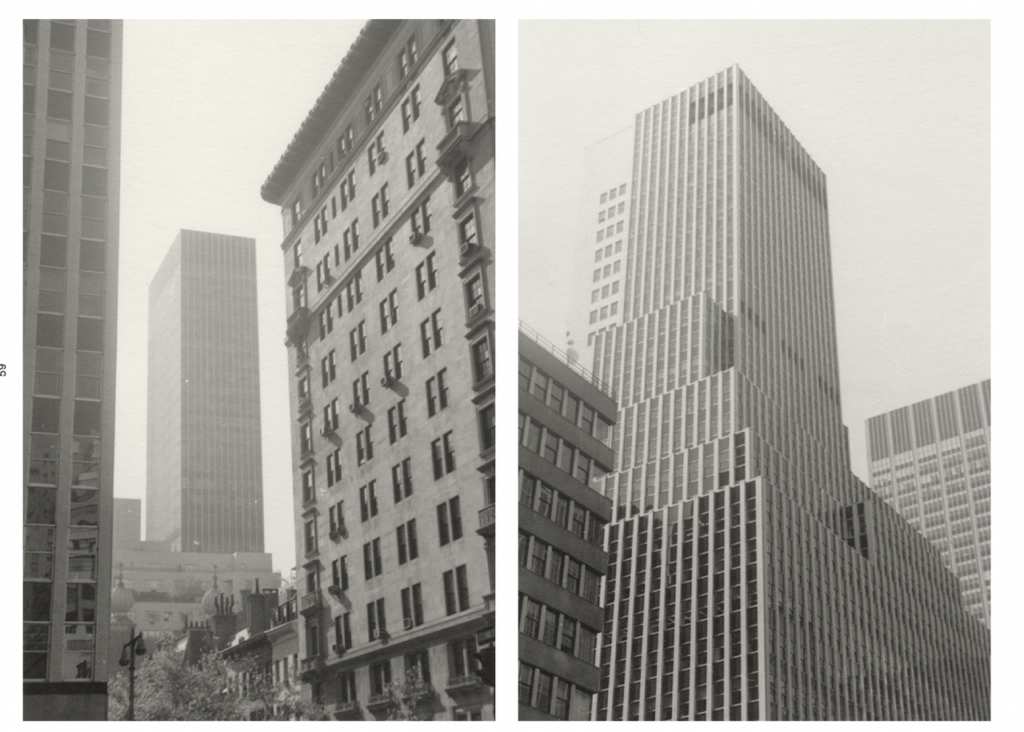
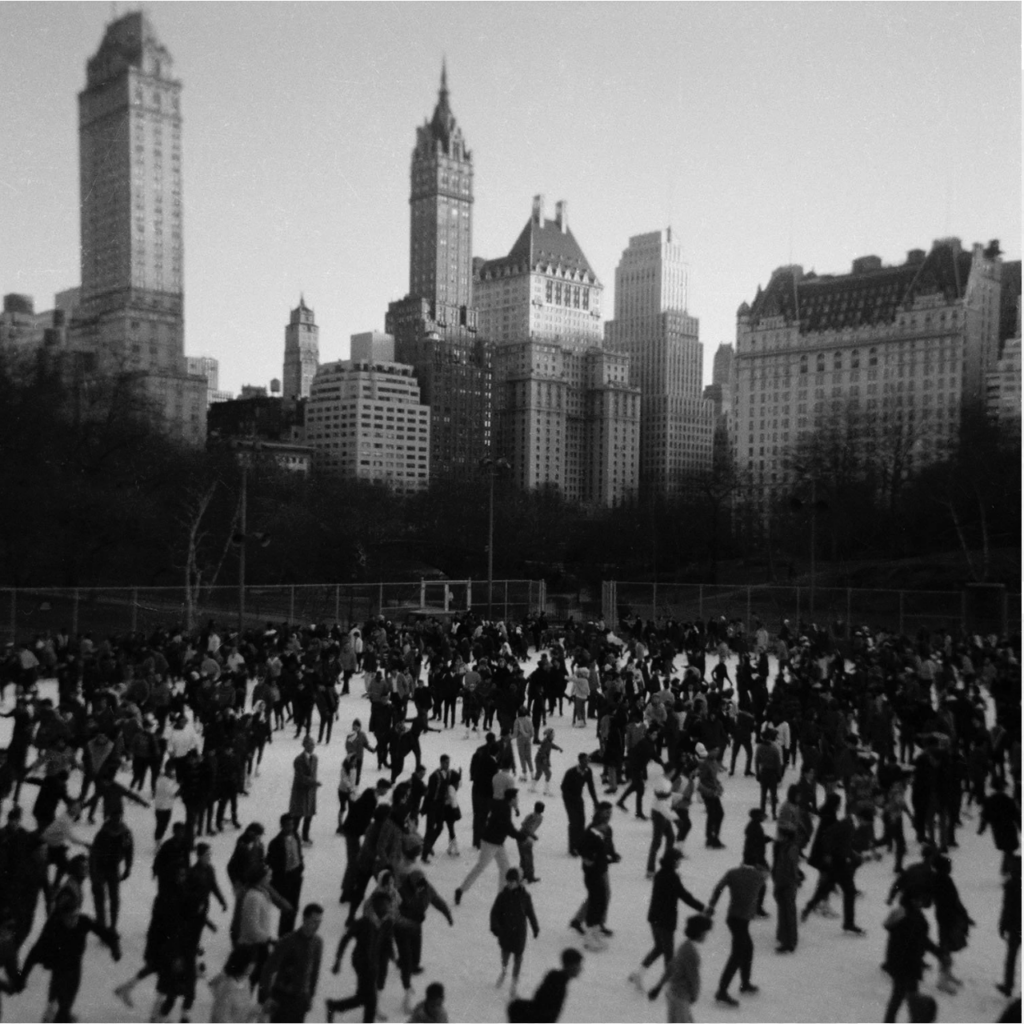
Seeing him smiling on the screen today, his bookshelves behind him stacked with everything from Giotto to Richter, brings me great pleasure. March 6th through April 24 2026, the Fondazione Studio Marangoni Gallery will be hosting a special exhibition titled “Archive Dialogues – La Misura del Visibile” in which the images by Abelardo that are housed in my precious collection will be put on display alongside those of other photographers who share similar sensitivities, result of an open call launched by our educational partner IFC – Iniziative di Fotografia Contemporanea.
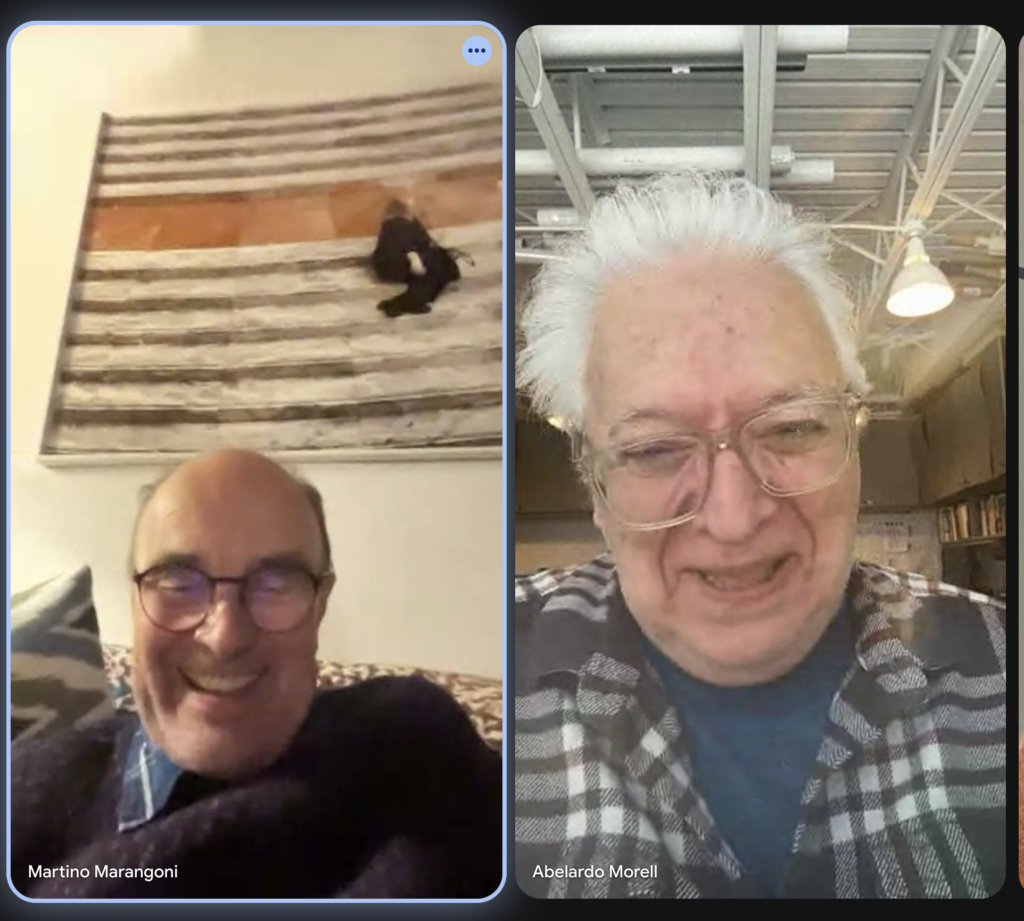
We decided to get together online and have a chat.
“I was young when I first picked up a camera, it was 1969 at Bowdoin College in Maine”, Abe reminisces, “I was struggling with academic work but I remember, from the very first roll of film, I could tell that photography was a language that I felt as my own… I had found a medium to express things, that hooked right on to my psyche. Being an immigrant made everything around me look a little odd, surreal even, which made it the perfect subject matter”.
I understand this feeling quite well since I’m dyslexic and words often don’t quite cut it. For both of us, it is simply easier to “get” things through images. We share a healthy distrust for people who speak too academically. As Abe puts it, “People who speak too academically are trying to shield certain things from common people.” What we do is about common living; it’s about the universal.
Our paths crossed again – and this time for real – in 1999. I was at the George Eastman House in Rochester, invited to bring “Il Profilo delle Nuvole” by Luigi Ghirri to the Visual Studies Workshop organized by the then associate director Nathan Lyons. My friend Gordon Knox told me that Abelardo was giving a lecture there so I jumped at the opportunity to meet him. I truly believe in serendipity; it is the lifeblood of the photographic process. If we recognize the opportunities life gives us, they enrich us for a long time.
Abe notes “When I met you in Rochester… there was no pretension when I told you I wanted to photograph Italy and you were generous and opened up new possibilities. Italy has become synonymous with you and your Institution. I remember you walking up to me with a grin and saying ‘Oh so you’re into Italy?’. You introduced yourself and told me all about the school. And that was that”. The next Summer Abe was invited to Italy by the Civitella Ranieri foundation for a residency in Umbria and took a detour to Florence.
I still remember when he was doing his early Camera Obscura pictures at my home. The exposures were six to eight hours long. “I felt like some kind of primitive man,” he says, “I did not feel like a photographer.” I remember one time he took a photo in my brother’s room and it was “forbidden” to enter for ten hours. I didn’t care—I knew what he was trying to do.
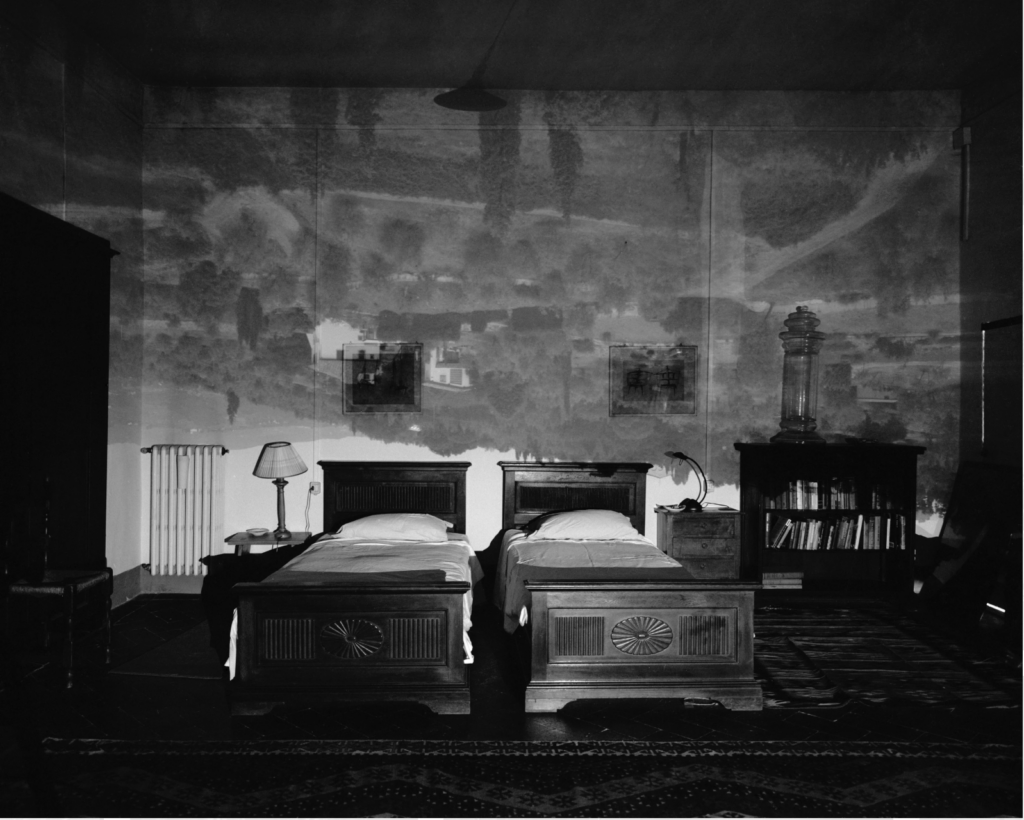
He took more in the following years. In one of his pictures you can see my living room, layered with the landscape. You can make out my partner Clare’s studio in another image, while another features a beautiful olive tree from my garden.
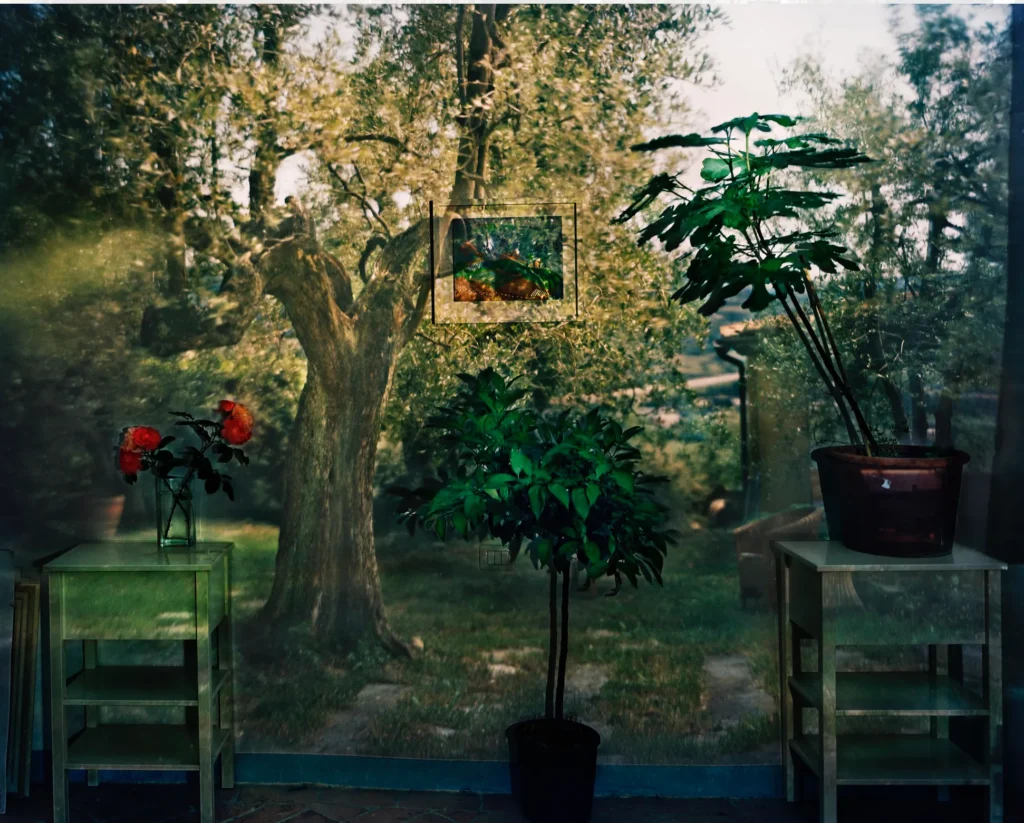
“I remember you helped me bring plants inside so that they could converse with the ones projected from outside, which I found extremely interesting…”. While the camera sat in the dark, we did the real work: chatting, eating, and enjoying Italian wine.
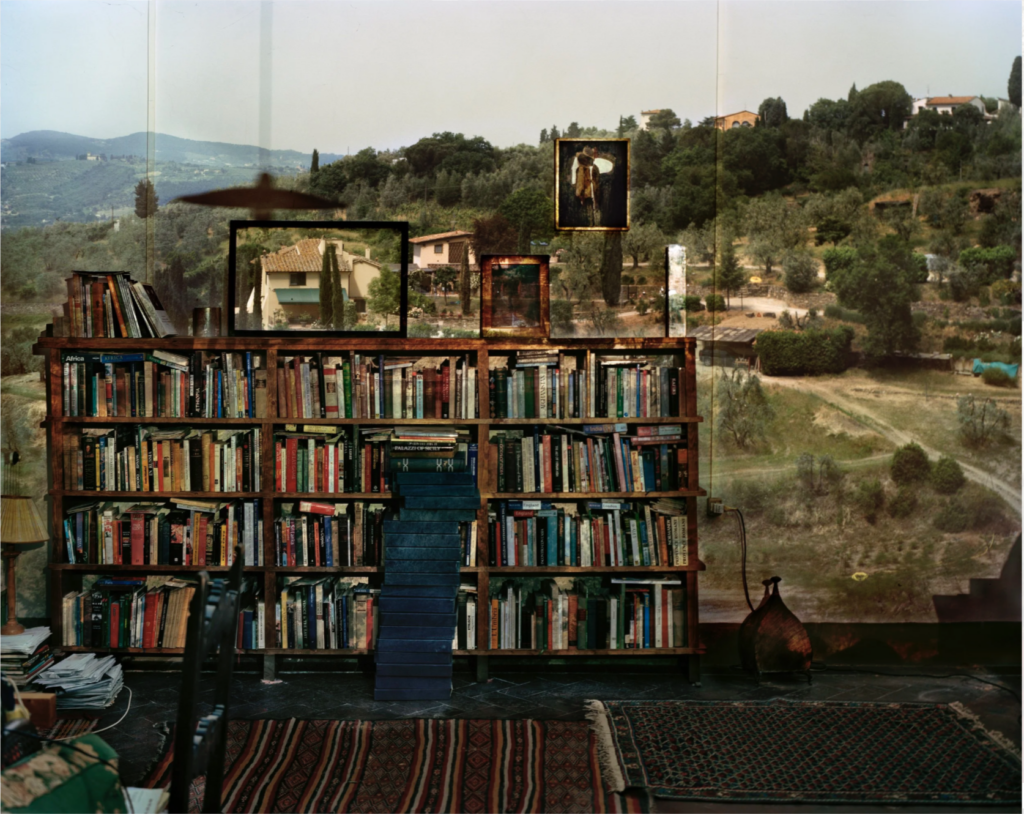
“We share a good sense of humor”, Abe chuckles. “My father, who is no longer with us, taught me that even in the darkest times a certain lightness can be used as an antidote…. I resort to it when the world feels like a dark place, when depression sets on or I fear that I have no more pictures to take.”
Unlike Abe who has often worked in the studio and with long exposures – initially in his Camera Obscura and later with his Tent Camera series, which also travelled to Florence – I’ve always found the tripod a little limiting. I’m impulsive; I think I took ten photos with a view camera before putting it aside because I didn’t have the patience. Abe is the opposite, though he claims to be just as impulsive as me. He just has the discipline to slow down for the sake of the image – and a good assistant to help rein him in.
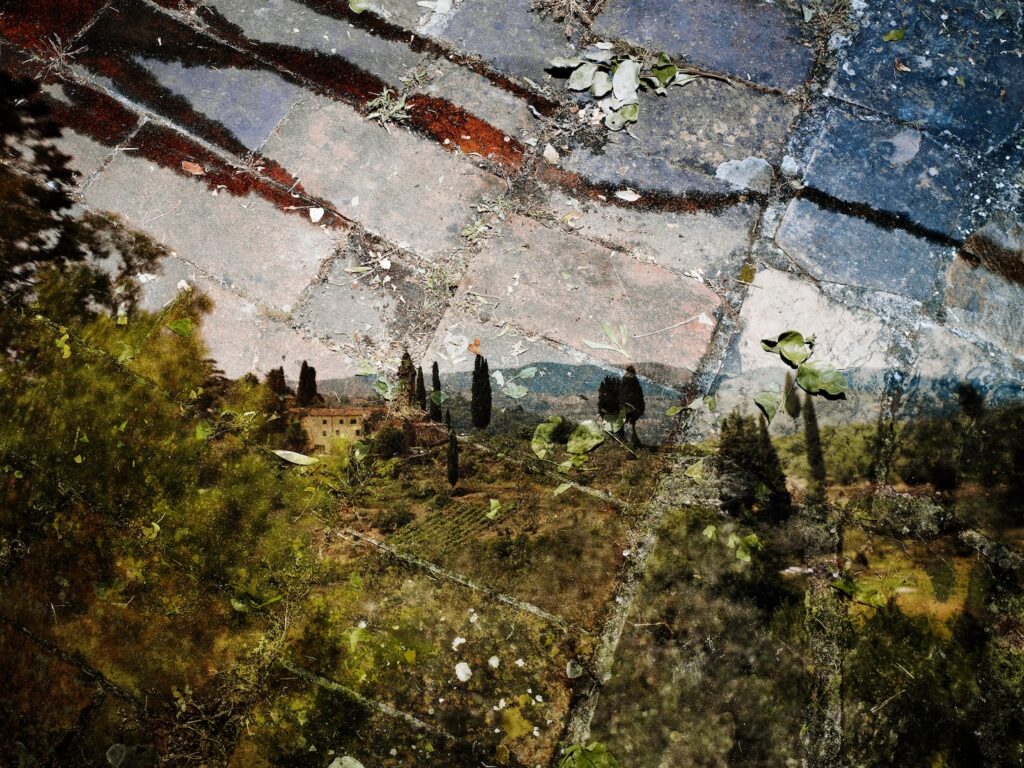
“Our work might be different in terms of output but there is something that unites us. To me your street photography has always had a very abstract sense of order, almost akin to modern art. The subject matters we both tend to like are philosophical places”.
What I admire most about Abe is that he doesn’t stay at one point doing the same thing. Most people get “typecast” once they find success. But as he says, “You want to suggest that the world is still interesting… there is a certain prison in following what is successful in your work, a form of crystallization. I like to quote Stanislavski: Love the art in yourself, not yourself in the art.”
Chatting via video, kilometers apart, we share our ideas on the importance of education. We are both committed teachers, though I often feel I am learning more than I am teaching. Meeting younger people and encouraging them to have a vision gives me hope.
Abe sees it the same way: “I love jazz music and I know that John Coltrane would have younger musicians playing with him, which helped him catch up, keep the crazy alive. It’s a question of exchanging energy… and it goes both ways. I remember when I started teaching at the Massachusetts College of Art in 1983… in 1985 I started turning classes into camera obscuras and even the most hip, cool, jaded students would walk into the room, eyes rounded in wonder. There was a basic sense of awe that I feel is important. It is an experience worth preserving”.
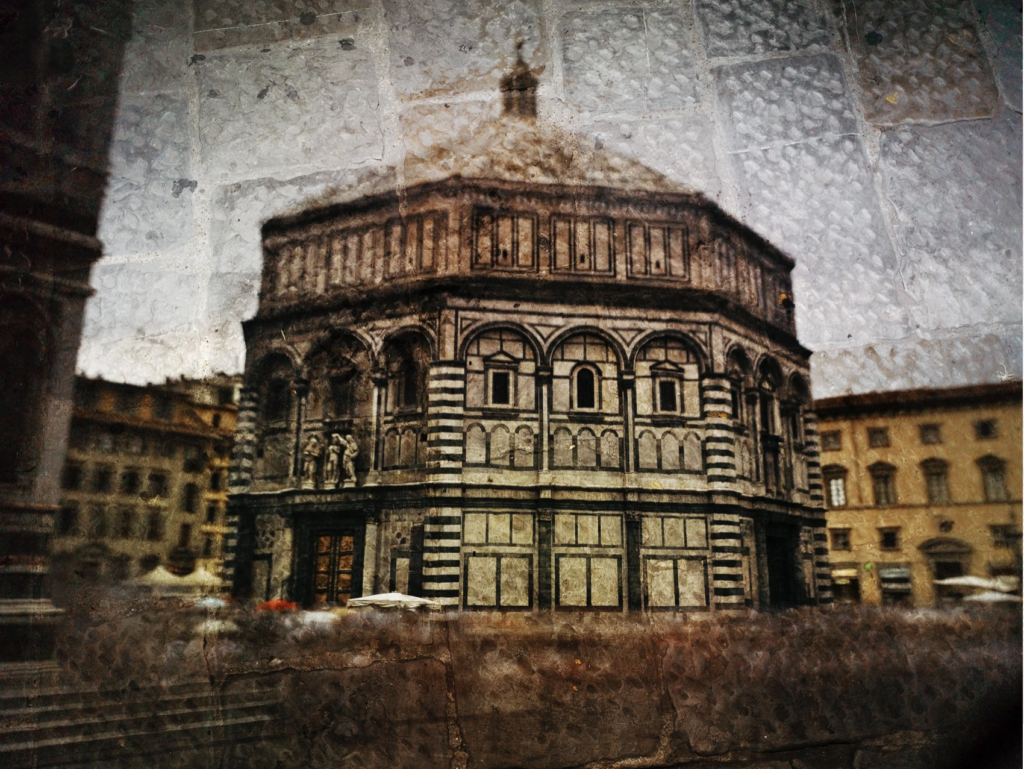
Abe partially borrowed a line from an E.E. Cummings poem, “pity this busy monster, manunkind”, for an exhibition of his titled “The Universe Next Door”, held in 2014 at the High Museum of Art in Atlanta… I find that this specific verse sums up our shared philosophy: “listen: there’s a hell of a good universe next door; let’s go.” That sense that every door conceals wonder is what saves us from becoming “angry old men.”
Whether it’s 1961 in New York or today in a Florentine villa, we are still those two boys with Brownies. We are still looking for beauty in the banal, still finding that “basic sense of awe” that makes life worth documenting. Don’t miss the exhibition opening this week on Friday March 6th at 6pm at FSM Gallery, Via San Zanobi 19R, Florence!